

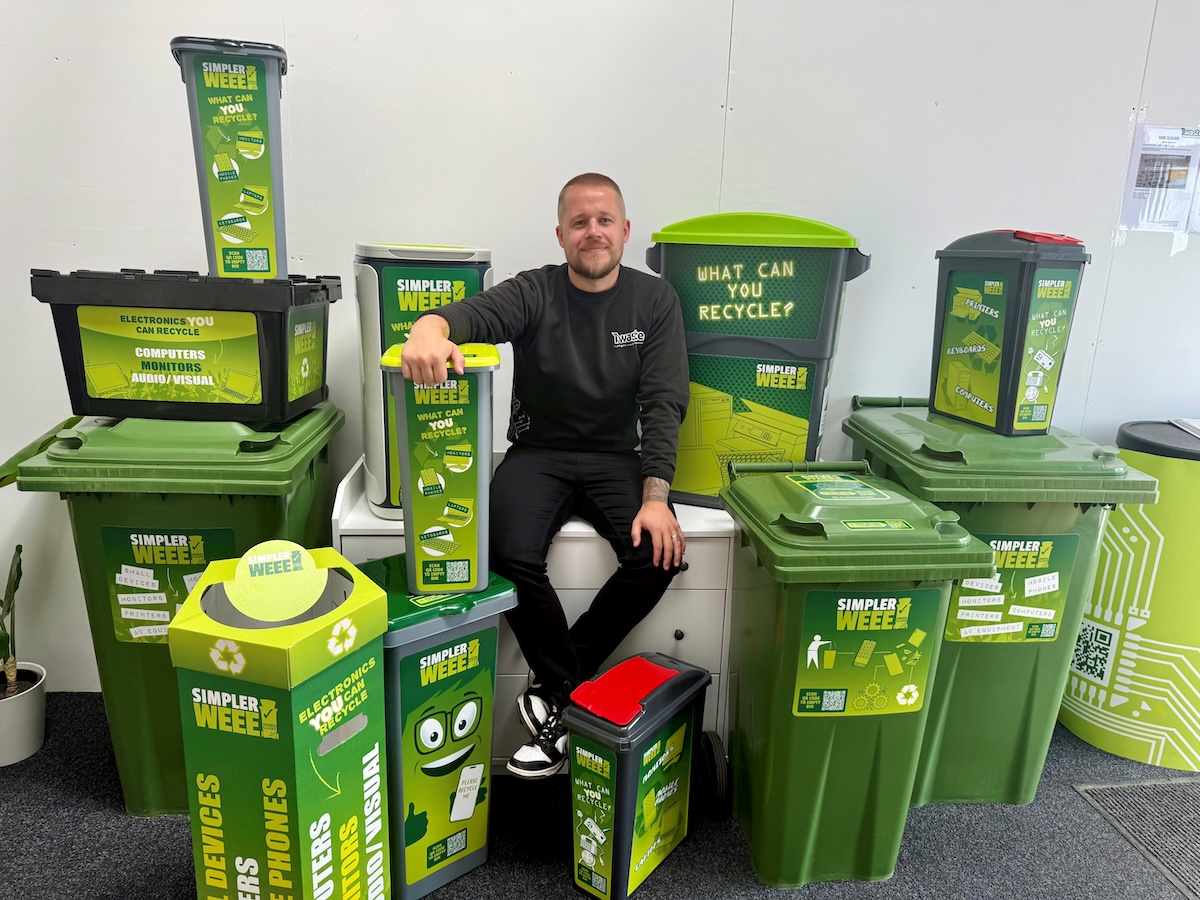
NEW INITIATIVE: Sam Mountain, iWaste’s Operations Director, with the huge range of recycling bins used in the firm’s SimplerWEEE scheme which he says would be perfect for Welsh businesses and organisations dealing with new electronics recycling rules from this month
It’s all change for Welsh businesses over small electrics and electronics recycling – and iWaste can help
Workplaces in Wales are now required to separate small Waste Electrical and Electronic Equipment (sWEEE) for recycling.
A new code of practice introduced this month [April] by the Welsh Government has changed the way businesses and organisations must operate.
The Welsh Government introduced the changes to improve the quality and quantity of recycling from workplaces and improve consistency in how waste is collected and separated.
National commercial e-waste specialist Intelligent Waste Management Ltd (iWaste) has introduced a new initiative to help businesses deal with the changes.
The SimplerWEEE scheme is a streamlined subscription service operating across Wales which ensures businesses do not fall foul of the legislation.
Latest available figures from the Welsh Government show there are an estimated 248,000 enterprises active in Wales, employing an estimated 1.2 million people.
Small and medium sized enterprises (SMEs) in Wales account for 62.3% of employment and 43.4% of turnover, with large enterprises accounting for the remainder.
Why is this happening?
The Welsh Government says 75% of the materials in old electricals can be recycled. If they go to landfill or incineration, valuable metals such as gold, copper, aluminium and steel are lost.
Using recycled materials from waste electricals to create new products reduces carbon emissions and environmental damage. Electrical items may only make up a small percentage of waste, but it can have a lasting impact.
Many small electrical items contain lithium-ion batteries. If these go in the general waste bin and end up being crushed, they can cause serious fires.
The Welsh Government says: “Wales is the best in the UK for domestic recycling and second in the world, but we can do more. This law supports Wales’ circular economy strategy, Beyond Recycling.”
What are the changes?
From 6 April 2026, workplaces have been required to separate any unwanted sWEEE items for onward recycling.
Businesses have been warned: It’s your responsibility to ensure you use a reputable, registered waste collector who will ensure your small waste electricals are transported, stored and recycled correctly.
Small waste electricals are any item with a plug, battery or cable which measures 50cm or less on every side – for example, unwanted laptops, phones, kettles, hairdryers, toasters, medical devices, lighting or power tools.
Electricals should be kept separate from other waste and recycled and not put in general waste or other recyclable waste streams. It’s worth checking with the item’s manufacturer in the first instance, as they often have a responsibility to take back electricals at the end of life.
If the item is a common item that can be used in both a household and non-domestic setting like a kettle, hairdryer or toaster (also known as a ‘dual-use’ item), check if it can go to a local in-store take-back scheme.
Alternatively, businesses can talk to their waste collector, local authority, or a specialist electrical recycler to arrange the drop-off or collection and onwards recycling of small waste electricals.
If waste electricals are hazardous, they will need to be managed in accordance with the Hazardous Waste (England and Wales) Regulations 2005. If not sure, assume it is hazardous and speak to the waste collector for advice to make sure it’s disposed of safely.
Who does this affect?
All businesses, charities and public sector organisations in Wales need to separate their waste.
This includes agriculture, hospitality and tourism (restaurants, bars, pubs, bed and breakfasts, hotels, campsites and caravan parks, holiday accommodation, and licensed premises), service stations and petrol stations, entertainment and sports venues (including leisure centres and showgrounds) and transport (bus stations, railway stations, seaports, airports, and heliports).
It also applies to care and nursing homes, pharmacies, GP surgeries, dental surgeries, and other primary care settings, construction sites, factories and warehouses, car garages, universities, colleges, and schools
The legislation also covers garden centres, heritage buildings, libraries and museums, offices and workshops, places of worship, prisons, retail and outdoor markets and festivals.
SimplerWEEE explained
iWaste’s SimplerWEEE initiative is a new service is designed for businesses that require small Waste Electrical and Electronic Equipment (sWEEE) recycling.
SimplerWEEE introduces a modern, efficient approach that eliminates the need for time-consuming phone calls and complex arrangements.
Businesses select a WEEE bin size (from 20 litres upwards) to suit their needs from the dedicated SimplerWEEE website, add artwork, choose a collection frequency and agree to a flexible subscription model with a minimum of two exchanges per year. Everything is done digitally with no need for time-consuming phone calls or meetings.
Then businesses can start disposing of electronic and electrical waste – any WEEE-compliant items – responsibly, including computers, accessories, mobile phones, tablets, small appliances, circuit boards and cables inside.
When the bin is full, the business submits a request and the iWaste team collects the bin promptly and ensures that all electronic waste is processed in line with environmental regulations – prioritising reuse, refurbishment, and responsible recycling – before providing the customer with documentation confirming compliance with legislation.
iWaste Director Sam Mountain says: “Businesses and organisations in Wales now face massive changes in the way electronic waste is stored and recycled – and we are here to help them make sense of it all.
“Our mission is to revolutionise the way businesses handle WEEE by providing a seamless, compliant, and environmentally responsible solution which involves no hassle, time-consuming phone calls or paperwork.
“We can offer SimplerWEEE at an affordable cost, a monthly subscription which gives peace of mind, because we will collect the bins – anywhere in mainland Wales – during iWaste’s routine collection routes and won’t need dedicated journeys.
“Our service is designed for businesses seeking a straightforward way to meet their environmental responsibilities without unnecessary complexity, offering effortless compliance, a user-friendly process and sustainably focused flexible solutions.
About iWaste
iWaste is based at Unit 4 Ducks Nest Farm, Eversley Road, Arborfield, Reading, RG2 9PJ, telephone 0330 1200 250, email hello@iwaste.co.uk
The company was established in 2013 by Sam Prentice and Sam Mountain. After many years of working in waste management, Sam and Sam recognised a distinct lack of industry-wide customer service.
With iWaste, they have addressed this absence by providing innovative processes that focus on offering seamless waste management to clients across the UK.
iWaste’s drive to provide flawless client services, in combination with the knowledge and experience possessed by the team, has helped iWaste gain a reputation as one of the UK’s most trusted E waste companies.
iWaste provides electronic waste collection services, secure data destruction, electronic recycling equipment and WEEE (Waste Electrical and Electronic Equipment) disposal for businesses across the UK.
The firm’s client portfolio includes corporations such as BP Oil, 3M and public sector organisations such as the NHS.