

England’s Simpler Recycling rules, introduced in March 2025, mean every business with 10 or more employees must now separate recyclable waste and food waste.
For smaller companies, compliance becomes mandatory in March 2027. But many offices worry that separating waste means filling precious floor space with bins.
The good news? You don’t need to turn your workspace into a bin yard. With the right setup, even the most compact office can recycle efficiently without clutter.
Below are five space-saving recycling setups designed to help SMEs and busy office managers stay compliant, tidy and green — all without sacrificing room to move.
1. Under-desk mini recycling bins for each workstation
Small, under-desk recycling bins (sometimes called desk caddies) are perfect for tight workspaces. They give every employee a convenient way to recycle paper, cans and packaging right where they work, without needing large communal bins.
These bins usually hold between 5–15 litres and fit easily under desks or in pedestal drawers. Many come colour-coded — blue for paper, green for mixed recycling — so employees instinctively know what goes where.
Why it works:
When recycling is within arm’s reach, it becomes effortless. Employees don’t toss paper or cans into the wrong bin out of convenience. The small size also prevents misuse — they fill quickly, prompting regular emptying into a central recycling point.
Example setup:
A 10-person marketing startup in a shared office gives each employee a mini recycling caddy for paper and packaging. At the end of the week, a designated person empties all caddies into the main recycling bin. Compliance? Check. Clutter? None.
Tips for implementation:
- Choose compact bins (5–15L) that slide under desks easily.
- Label or colour-code bins clearly to reinforce recycling habits.
- Set a schedule for emptying into central collection bins.
- Pair each mini recycling caddy with a tiny general waste pot to highlight how little landfill waste should remain.
2. Stackable “recycling towers” for tight corners
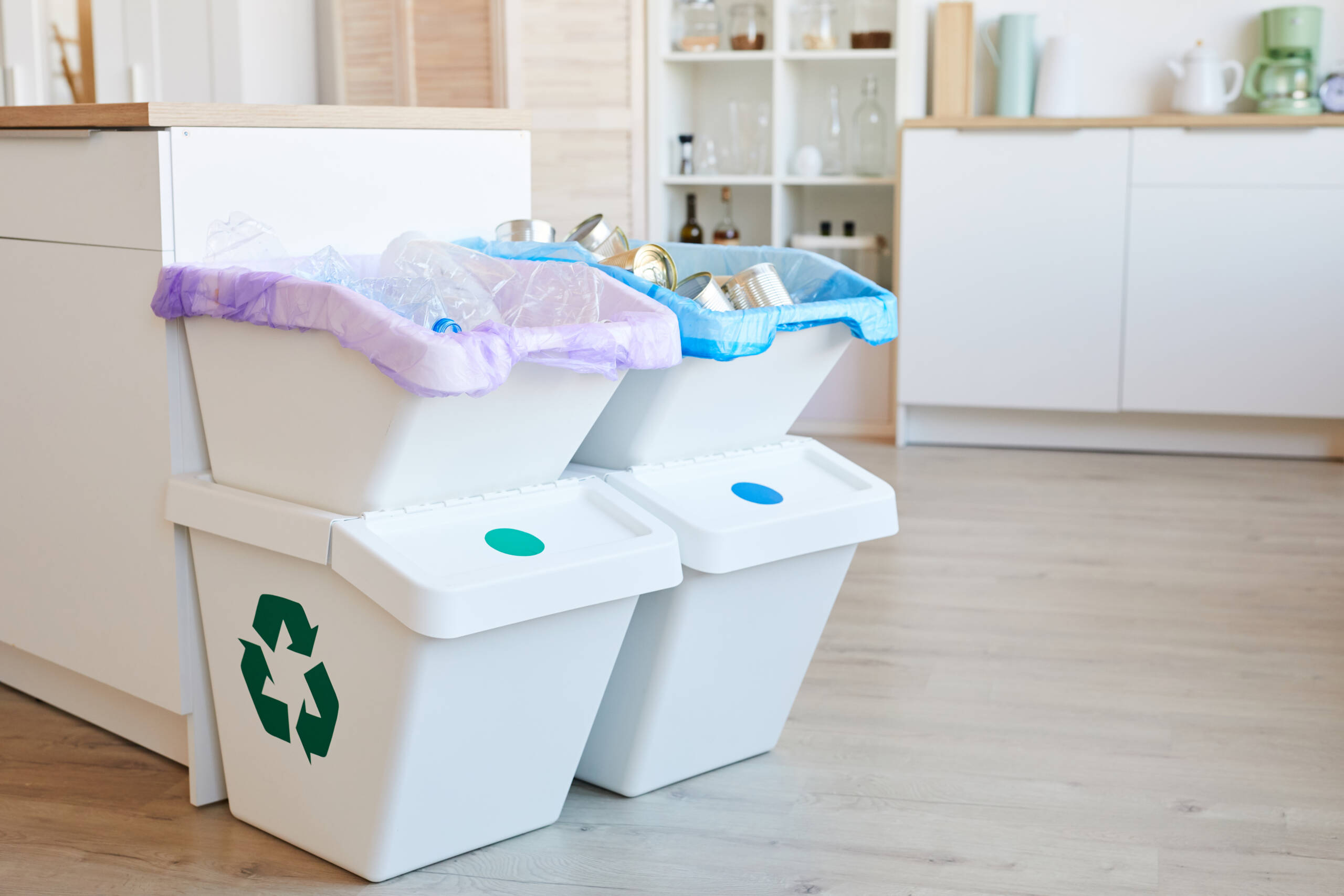
When floor space is limited, go vertical. Stackable recycling towers let you combine multiple waste streams into one slim, upright unit. Think of them as modular bins that slot neatly on top of each other.
How it works:
Each tier collects a different waste stream — paper at the top, plastics and cans in the middle, general waste at the bottom. Some designs interlock securely, while others use lightweight frames or clips. The result? A single, compact recycling station that fits in a corner, hallway or under a counter.
Why it’s ideal for small offices:
A three-tier stack can hold up to 100 litres across the bins, but only takes up about 40×33 cm of floor space — smaller than a side table. Perfect for micro-offices, co-working kitchens or copy rooms.
Real-world example:
A small architecture studio with limited space installs a 3-bin stack near the printer area. Paper goes on top, plastics in the middle, and non-recyclables at the bottom. The whole system takes up barely any room, but ensures proper separation.
Tips for implementation:
- Use sturdy interlocking bins and keep heavier materials (like glass or paper) at the base.
- Label each level with icons or colours (e.g. blue = paper, green = recycling, black = waste).
- Place towers in quiet corners or by high-traffic areas like kitchens.
3. Compact multi-stream recycling stations
If your office generates more waste, modular multi-stream stations are the way forward.
These systems combine several waste types into a single, unified piece of furniture. A typical unit might have three sections — one for mixed recycling, one for food waste, and one for general waste.
The advantage:
Everything is in one place. Employees don’t have to hunt for the right bin, and cleaners can empty all streams together quickly. Multi-stream stations save space by replacing several standalone bins with a single slimline setup.
Why offices love them:
Modern stations are sleek and design-conscious. You’ll find models that match office furniture, with clean lines, subtle colours and even woodgrain finishes. Built-in labels and colour-coded lids reduce confusion while keeping things professional.
Example:
A tech company installs two three-stream stations — one in the break area, one in the main workspace. Recycling rates jump by 30%, and the facilities team saves time on cleaning because everything is contained in one easy-to-manage spot.
Tips for implementation:
- Pick a size that fits your traffic level (50–70L per stream for busier areas).
- Match bin colours to UK recycling standards: blue for recycling, green for food, black/grey for general waste.
- Keep stations uniform for a clean, cohesive look.
4. Centralised recycling zones (no bins at desks)
Removing personal desk bins might sound inconvenient — but it’s one of the most effective ways to improve recycling and save space. Centralised recycling zones group all your bins in a few key spots: kitchens, copy areas or corridor corners.
Why it works:
When employees walk to a central station, they make a conscious decision about where their waste goes. Without under-desk bins, there’s less temptation to toss recyclables into general waste. Many offices that have gone “desk-bin-free” report recycling rates rising by 30% or more.
Space and efficiency benefits:
Eliminating dozens of small bins clears legroom and declutters offices. Cleaning teams save time too — they only empty a few central bins instead of every desk. It also reduces the number of plastic liners used each week.
How to do it:
- Choose 3–4 well-placed recycling zones (e.g. kitchen, lift lobby, print area).
- Use large, clearly labelled bins for Mixed Recycling, General Waste and Food Waste.
- Add clear signage above the bins — posters or icons work well.
- Communicate the change with staff in advance to encourage buy-in (“Goodbye desk bins, hello recycling hubs!”).
Real-world example:
A co-working hub replaces 50 desk bins with four central recycling islands. Within a month, general waste drops sharply, cleaning time halves, and employees embrace the cleaner, more open layout.
5. Integrated tech and e-waste collection (SimplerWEEE bins)
Electronic waste is often overlooked — but it’s one of the fastest-growing waste streams in offices. From old cables and computer accessories to broken keyboards, most of it doesn’t belong in your general bin. Setting up a dedicated e-waste station ensures compliance and prevents valuable materials from ending up in landfill.
SimplerWEEE bins make this easy. They fit alongside your existing bins and integrate seamlessly with your recycling routine.
When the bin is full, simply scan the QR code, and SimplerWEEE arranges collection and recycling through certified partners. You’ll receive digital proof that your electronics were recycled responsibly.
What to collect:
Small electronics such as phones, chargers, mice, keyboards, and desk gadgets. For larger equipment (like monitors, laptops, or printers), create a designated tech drop-off point and schedule periodic collections.
Why it’s worth doing:
Proper e-waste handling helps prevent data breaches, supports material recovery, and reduces environmental impact. It also declutters your workspace and demonstrates your commitment to sustainability.
Final thought: recycling that fits your space
Space shouldn’t stand in the way of sustainability. Whether you’re managing a startup in a serviced office or a large hybrid workspace, these five setups help you meet Simpler Recycling requirements without overcrowding your floorplan.
With smart bin placement, clear signage and the right products, you can make recycling easy, intuitive and clutter-free — proving that green initiatives and good design go hand in hand.